

Nearly every call for lawn sprinkler service in Ann Arbor, MI, opens with the same sentence: there is a patch of lawn that stays brown no matter how long the system runs. That patch is rarely a watering-duration problem. It is a coverage problem, and running the zone longer usually makes the rest of the lawn soggy without fixing the spot at all.
Great Outdoors has cared for lawns and landscapes across the Ann Arbor area for over 40 years, and the same diagnosis comes up season after season. The controller is almost never where the problem lives.
This piece covers how coverage actually works, why zones matter more than minutes, what a service visit should include, and how the Michigan season shapes the calendar. If you have been adding time to a controller every July and getting the same result, the explanation is probably in here.
Related: Maintaining Green Excellence: Tips for Lawn Service in Ann Arbor, MI
Why Does One Patch Stay Brown While The Rest Of The Lawn Is Fine?
Sprinkler systems are designed on a principle called head-to-head coverage, which means every head throws far enough to reach the heads beside it. Overlap is not waste, it is the design. Water lands heaviest near each head and lightest at the edge of its throw, and overlapping those patterns is what produces an even application across the whole area.
Break the overlap anywhere and you get a dry spot. A head that has sunk an inch below grade, been knocked out of alignment by a mower, had its arc changed by someone trimming, or is running at low pressure because of a leak elsewhere in the zone will fall short of its neighbor. The gap between them receives water from neither.
That is why adding minutes does not help. The dry patch is receiving a fraction of what its neighbors get, so doubling the run time doubles a small number while flooding everything around it. The fix is at the head, not the controller.
How Do Zones Determine What Your System Can Do?
A zone is a group of heads on one valve, and every head in a zone runs for the same length of time. That single constraint drives most of what goes right or wrong in a system, because different areas of a property want very different amounts of water.
A sunny front lawn, a shaded rear lawn under mature oaks, a bed of established shrubs, and a strip along a south-facing driveway all have different requirements. Put them on one zone and you are choosing which of them to serve properly. Separate them, and each can be scheduled for what it needs.
Head type matters within a zone too. Spray heads and rotors apply water at very different rates, and mixing them on one valve guarantees that one group is over-watered while the other is under-watered. This is one of the most common design faults we find on older systems in the area, and it cannot be corrected at the controller.
Pressure And Flow, The Limits Behind Everything
Every property has a finite amount of water available at a given pressure, and that number sets how many heads can run at once. A zone with too many heads for the available flow produces heads that mist rather than throw, which drifts in the wind and falls short of the design radius. If your system looks like fog rather than water, the zone is overloaded.
Static pressure and flow are two separate measurements, and both get checked before anything is diagnosed. Static pressure is what the line holds at rest. Flow is what the line delivers while water is moving, and it is the number that determines how many heads a zone supports. A property with good pressure and restricted flow behaves like a property with neither.
Pressure that runs too high causes its own failure. Misting is the visible symptom, and fixture wear is the invisible one, since heads and fittings rated for a range are being run above it. A pressure-regulating head or a regulator at the valve costs less than the repairs that follow years of running unregulated.
What Should A Sprinkler Service Visit Actually Include?
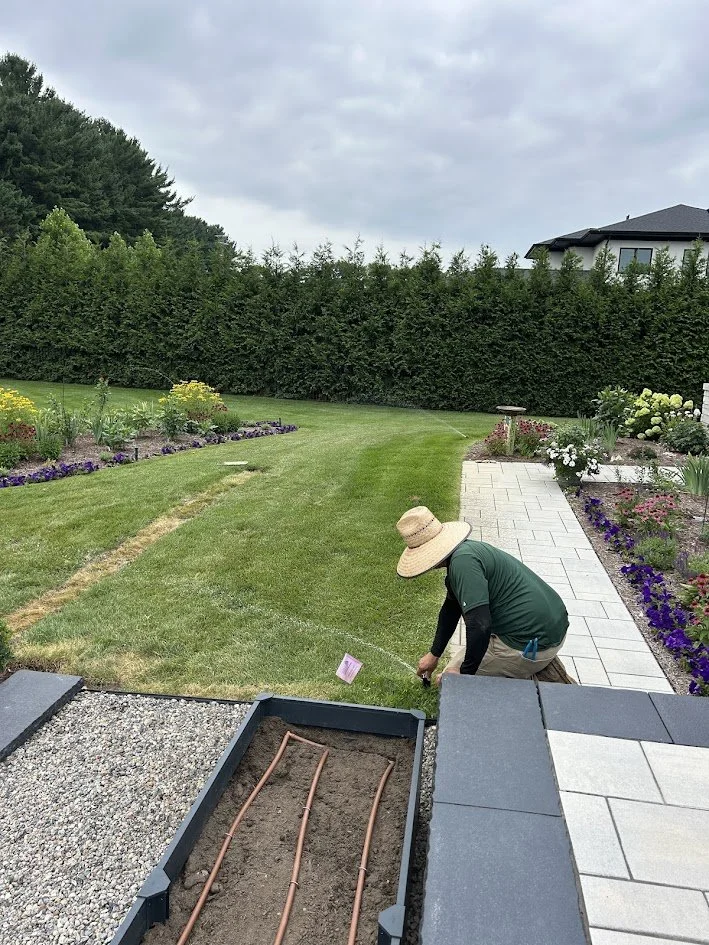
A proper visit runs every zone and watches it. That means standing in the yard while each zone cycles, checking arc and radius on each head, looking for misting, watching for heads that fail to pop up fully, and finding the wet ground that gives away a leak.
Heads then get adjusted, raised where they have settled, cleaned where nozzles are partly blocked, and replaced where a case is cracked. Nozzles are matched so that heads within a zone apply water at compatible rates.
Then the controller gets programmed against what the system can actually deliver rather than against a default schedule. Our service visits are built around that sequence, because a visit that only checks for leaks has verified the system is not broken without establishing that it works.
How Should A System Be Scheduled Through A Michigan Season?
Water demand is not constant, and a schedule set in June is wrong by September. Cool-season turf in this area uses considerably more water in late July than it does in May or in the first weeks of autumn, and a controller left on one program either wastes water for half the season or under-waters during the peak.
The general target is deep, infrequent watering rather than daily light applications. Deep cycles push roots downward and produce a lawn that tolerates dry stretches. Daily short cycles keep moisture in the top inch, roots stay shallow, and the lawn becomes dependent on the system.
Early morning is the productive window. Watering before sunrise reduces evaporation loss and lets blades dry through the day, which matters for disease pressure in a humid Michigan August. Evening watering leaves foliage wet overnight, which is the opposite of what you want.
On sloped ground and heavy soil, cycle-and-soak scheduling does the work that one long run cannot. Splitting a zone into two or three shorter cycles with a gap between them lets water infiltrate rather than run off toward the street, and it is the single most useful adjustment on many properties in this area.
When Should Winterization Happen Here?
Before the first hard freeze, and that is a firmer deadline than most homeowners treat it as. Water left in lateral lines and heads expands when it freezes. The resulting damage ranges across cracked heads, broken risers and split lateral pipe, and that last category is an excavation rather than a repair.
Proper winterization means blowing the lines out with compressed air zone by zone, at a controlled pressure. Too little air leaves water behind; too much damages fittings and heads. Draining valves alone is not sufficient in this climate, whatever an older system's manual says.
Scheduling in autumn fills quickly, for the same reason every seasonal service does: the window is short and every property shares it. Booking in early autumn for a late-season blowout is the arrangement that works, rather than calling during the week of the first freeze warning.
What Does Spring Startup Involve?
Startup is more than turning the water back on. Lines are pressurized gradually to avoid the pressure surge that cracks fittings, then each zone is run and inspected the same way a mid-season service visit would inspect it. Winter moves heads, and freeze heave lifts and tilts them.
Backflow prevention gets checked at startup as well, since that assembly protects the drinking water supply and is the part of the system with a regulatory dimension rather than only a horticultural one.
Controller programming gets reset for spring conditions, which are far wetter than midsummer. Systems left on last August's program in April are the most common cause of the soggy lawns we get called about in May.
Related: How Outdoor Living & Landscape Design in Milan, MI, Is Responding to Climate and Lifestyle Shifts
How Does Irrigation Interact With The Rest Of The Lawn Program?
Irrigation is the input every other lawn service depends on. Fertilizer requires moisture to move into the root zone. New seed requires consistent surface moisture during establishment. Aeration and overseeding scheduled without a working system is a considerable investment placed at the mercy of September rainfall.
It runs the other way too. A lawn with compacted soil sheds irrigation water rather than absorbing it, so a system that tests perfectly can still fail to deliver results. Our lawn care and maintenance program and the irrigation work are coordinated for that reason rather than sold as unrelated services.
On properties where new planting or hardscape is going in, the irrigation layout should be revisited as part of the work. Beds change, plant water requirements change, and surfaces change where water can land. A landscape design and construction project that leaves the original zone layout untouched frequently produces watering problems in its first season.
What Are The Signs A System Needs More Than A Tune-Up?
Persistent dry spots that return after adjustment suggest a design issue rather than a maintenance one, usually spacing that was not adequate to begin with. Zones that mist rather than throw indicate overloading. Frequent valve failures point at electrical or water-quality issues upstream.
Age is a factor as well. Systems installed decades ago were designed around different head technology and around a lawn that may since have grown mature trees, added beds, or been re-graded. The system is not failing so much as solving a problem the property no longer has.
Where that is the case, a partial redesign of one or two zones is often more economical than repeated service calls on a layout that cannot deliver even coverage. We would rather say so than keep adjusting heads that are working correctly and still cannot reach each other.
What Does Uneven Coverage Cost Over A Season?
More than the water bill, though the water bill is the part homeowners notice. A zone run long enough to keep its weakest corner alive is over-applying everywhere else, and saturated turf brings its own set of problems: shallow rooting, compaction, and the moisture conditions several turf diseases prefer.
Over-watered areas also waste fertilizer. Nutrients applied to ground that stays saturated leach below the root zone rather than staying available, which means a property can be on a sound fertilization program and still show deficiency symptoms. Correcting the irrigation frequently fixes what looked like a fertility problem.
Then there is the runoff. Water applied faster than soil can absorb it leaves the property, and on the heavier soils common across Washtenaw County that threshold is reached sooner than people expect. Every gallon that reaches the street was paid for twice, once at the meter and once in the lawn that did not get it.
None of that is visible from the driveway, which is the difficulty. A system can look like it is working perfectly while quietly doing all four of these things, and the only way to know is to watch it run.
How Do Mature Trees Change An Older System?
Established neighborhoods around Ann Arbor have canopies that have been growing for decades over irrigation designed when those trees were considerably smaller. Shade reduces evaporation and lowers the water requirement in that area, while the tree itself draws heavily from the same soil, and those two effects do not cancel out neatly.
Roots also intercept the spray pattern. A head that had a clear throw fifteen years ago is now firing into a trunk or a low branch, shadowing everything behind it. Raising the head, relocating it, or changing the nozzle usually resolves it, but only if someone has actually watched the zone run.
Turf under mature shade wants a different program entirely: less water, less frequently, and a realistic conversation about whether turf is the right ground cover in the deepest shade. Where it is not, changing the planting is a more durable answer than changing the schedule.
This is the most common reason a system that once performed well no longer does. Nothing broke. The property grew, and the irrigation layout stayed where it was, which is a slow mismatch rather than a failure and is why it goes unnoticed for years.
Get Your Ann Arbor Sprinkler System Working The Way It Should
When the same patch of lawn browns out every summer, the answer sits in the coverage rather than the controller, and it takes a technician standing in the yard watching each zone run to find it.
Our team at Great Outdoors will test the system head by head, adjust or repair what is off, and program a schedule that matches the season rather than a default.
Contact us to book a sprinkler service visit or a winterization date for your Ann Arbor property before the autumn calendar fills.
In Summary
How often should an irrigation system be professionally checked?
Twice a year covers most properties: a spring startup with a full zone-by-zone inspection, and an autumn winterization before the first hard freeze. A midsummer check is worth adding on larger properties or where mowing traffic regularly knocks heads out of alignment. The rest of the season is mostly controller adjustment, which is something we can walk a homeowner through.
Does a lawn on heavy clay need a different watering approach?
It does, and much of the Ann Arbor area sits on soil heavy enough to matter. Clay accepts water slowly, so a single long run produces runoff toward the street rather than moisture at the root zone. Splitting each zone into two or three shorter cycles with a soak period between them delivers the same total volume with far less waste, and most modern controllers can be programmed to do it automatically.
What areas does the irrigation crew cover around Ann Arbor?
Great Outdoors runs irrigation routes across Washtenaw County and into the neighboring townships, including Ann Arbor, Dexter, Chelsea, Saline, Scio Township, Pittsfield Township and Salem Township. Autumn winterization is scheduled geographically so crews stay in one area per day, which is how we hold firm dates during the few weeks when everyone wants the same service.